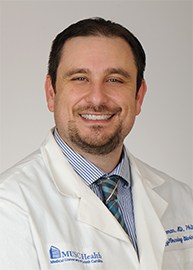
Toros Dincman, M.D., Ph.D.
Identification and molecular characterization of genetic alterations that impact cancer prognosis and therapeutics.
Research Interest
I have a strong interest in understanding cell transformation and limiting toxicities that may be associated with existing cancer therapies. During my Internal Medicine residency and Hematology/Oncology subspecialty training at Medical University of South Carolina (MUSC) in the Physician-Scientist Training Program (PSTP), I was awarded a T32 Post-Doctoral Fellowship in Integrative Training in Oncogenic Signaling (ITOS) at Hollings Cancer Center at MUSC under the guidance of Dr. Philip Howe, Chair of the Department of Biochemistry & Molecular Biology. In addition to co-first authoring a review discussing the role of the methyltransferase enhancer of zeste homolog 2 (EZH2) in lung cancer progression and evaluating the significance of serial monitoring circulating tumor DNA (ctDNA) in metastatic Prostate Cancer prognosis, I also began investigating the role of poly(rC)-binding protein 1 (PCBP1)/hnRNP E1 mutations in colorectal cancer (CRC). As I transitioned to a junior faculty position as a physician-scientist, I was appointed as a South Carolina Translational Research (SCTR) Institute KL2 Scholar with Dr. Howe as my mentor. To accompany this work in CRC, I also received a grant from The Fred J. Brotherton Charitable Foundation to evaluate genomic and stromal features in pancreatic ductal adenocarcinoma (PDAC) and their influence on response to neoadjuvant therapy, cachexia, survival, and other clinical outcomes.